
An acquisition mailing can be one of the first major communications between an organization and a newly acquired group of customers, members, policyholders, borrowers, donors, or subscribers.
The organization may know how many pieces were mailed and, eventually, how many envelopes were physically returned. But those numbers reveal only part of the story.
What happens after the mail enters the postal system can reveal valuable information about campaign performance. Delivery-related activity, forwarding and change of address activity, potential return conditions, and trends across geographic areas or customer segments can all help create a clearer picture.
Activity associated with the U.S. Postal Service’s Postal Automated Redirection System (PARS) can help pull back the curtain on that part of the mailing process.
Why Acquisition Mailings Present Unique Challenges
Acquisition data may pass between organizations, platforms, business units, or legacy systems before a mailing ever takes place. Even after the data has been standardized and processed through address quality tools, important questions may remain:
- How current are the addresses?
- Which records experienced forwarding or change of address activity?
- Are potential address issues concentrated geographically?
- Did certain acquisition sources perform better than others?
- Which records may require additional review?
Traditional return mail processing can help answer some of these questions, but the process takes time. Physical returns may arrive over several days or weeks, leaving staff to review individual mailpieces, interpret endorsements, and manually enter the results into internal systems.
For a large acquisition campaign, that process can be time-consuming and difficult to analyze consistently.
Looking Beyond the Returned Envelope
PARS is the USPS system used to identify and redirect certain undeliverable-as-addressed letter mail during postal processing. Related operational events may also appear within USPS Informed Visibility Mail Tracking & Reporting data.
Organizing these events into understandable categories can offer earlier insight into:
- Delivery-related activity
- Forwarding and change of address trends
- Potential return conditions
- Geographic concentrations
- Records requiring additional review
This information does not eliminate every physical return or provide a definitive outcome for every mailpiece. A missing scan does not necessarily mean a mailpiece was not delivered, and an operational event may not always confirm final delivery. However, this information can provide an earlier view of mailing activity while return mail is still arriving.
Connecting Postal Activity to Mailing Records
A summary report can describe the mailing as a whole, but connecting relevant USPS Operations Codes or related operational categories to individual records allows for deeper analysis.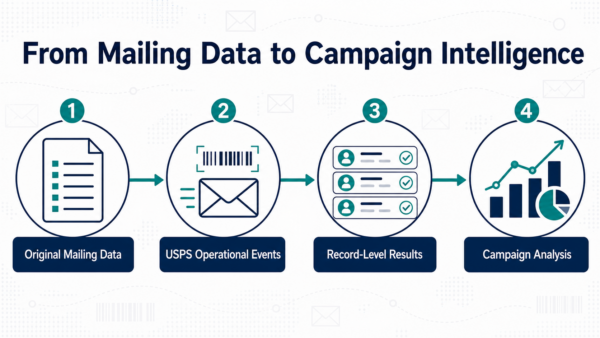
Once that operational information is connected to individual records, the focus can move beyond one basic question:
How much mail was returned?
The organization can begin looking deeper:
- Which segments experienced the most address-related issues?
- Did outcomes vary by geography?
- Were certain acquisition sources more reliable?
- Which records should be prioritized for address remediation?
- What can be learned before the next communication is produced?
This is where postal reporting begins to become actionable business intelligence.
Turning Operational Data into Campaign Intelligence
USPS operational and scan event codes can be difficult to interpret individually. Grouping relevant codes into understandable business categories makes the information easier to evaluate and apply.
Results can then be compared across key campaign dimensions such as:
- Acquisition source
- Customer or member segment
- Product or program
- State, region, ZIP Code, or market
- Internal business unit
A mailing with an acceptable overall result may still contain segments with unusually high forwarding or potential return activity. At the same time, an acquisition source that appears questionable overall may perform well within particular markets.
Those differences can remain hidden when analysis is limited to the total number of returned envelopes.
From Mailing Results to Future Action
The information becomes most valuable when it helps guide what happens next. Organizations can use these findings to:
- Prioritize records for address review
- Evaluate acquisition source quality
- Identify geographic concentrations of address issues
- Improve data maintenance procedures
- Refine future campaign segmentation
- Establish benchmarks for subsequent mailings
The goal is not simply to produce another postal report. It is to build a repeatable analytical process that helps organizations better understand their newly acquired populations and make more informed decisions about future communications.
Making Postal Intelligence More Actionable
EdgeMark helps organizations turn USPS operational reporting into record-level campaign intelligence.
EdgeMark connects relevant operational events to individual mailing records, translates technical codes into understandable categories, and compares results across key campaign segments. This process helps organizations identify patterns that can guide address remediation, acquisition source evaluation, and future campaign planning.
For organizations managing large or complex acquisition mailings, this added visibility can reveal far more than the number of envelopes that eventually come back. It can help show what happened after the mail entered the postal system and what the organization may want to do next.
Planning a large acquisition mailing? Contact EdgeMark Partners to learn how record-level postal intelligence can help evaluate mailing outcomes and acquisition-source quality.
